
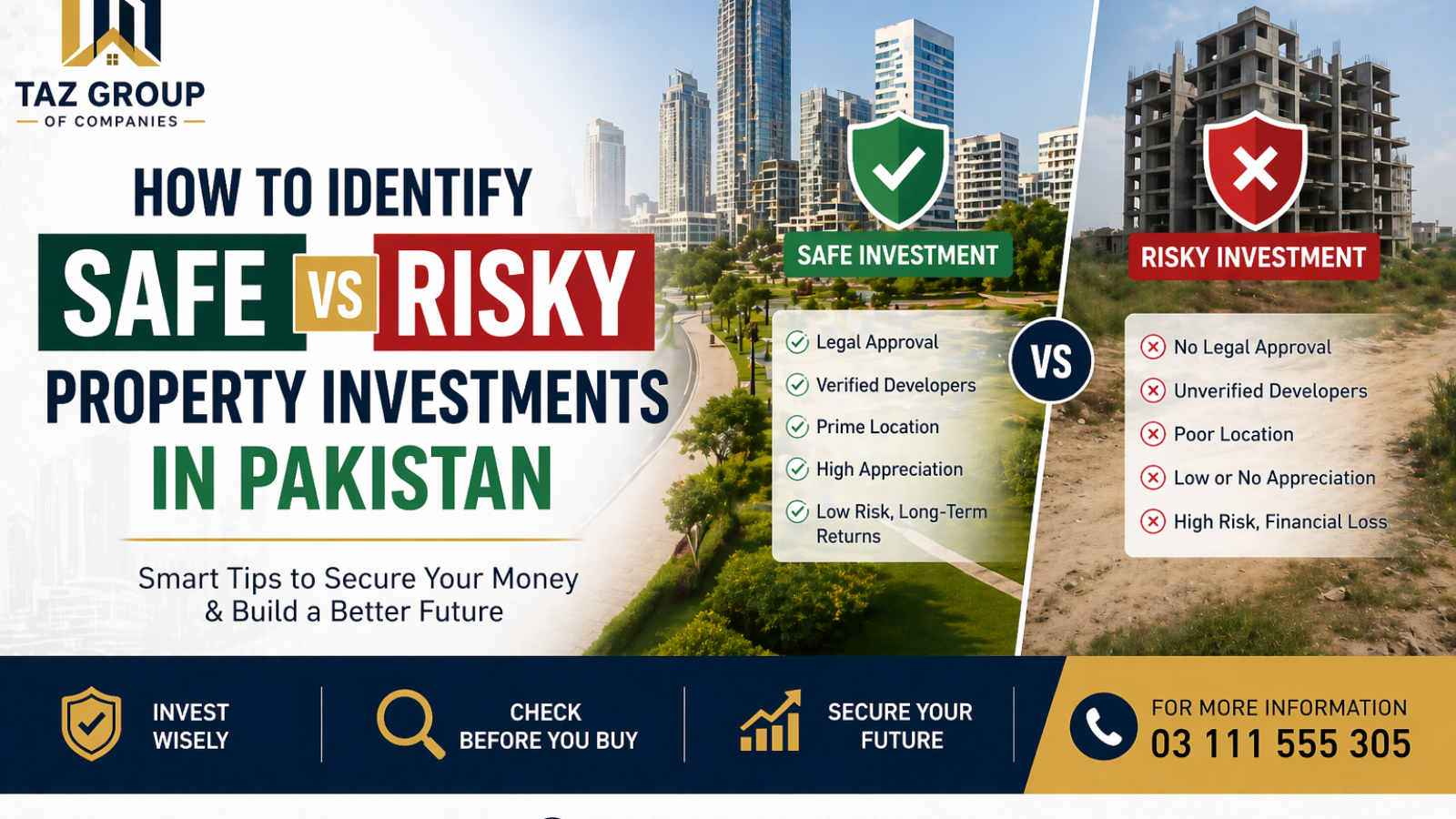
Real estate in Pakistan has long been considered one of the most reliable ways to build wealth. From residential plots to commercial developments, the opportunities are vast—but so are the risks.
Every year, thousands of investors enter the market. Some make excellent returns, while others face losses due to poor decisions, lack of research, or falling into misleading schemes.
So, how do you separate a safe investment from a risky one?
In this blog, we’ll break down the key factors that define safe vs risky property investments in Pakistan and give you a practical framework to make smarter decisions.
Why Identifying Risk Matters in Real Estate
Unlike stocks or small investments, property deals often involve large amounts of capital. A wrong decision can result in:
- Financial loss
- Legal complications
- Delayed returns
- Long-term stress
That’s why risk analysis is not optional—it’s essential.
What Defines a Safe Property Investment?
A safe property investment is one that offers:
- Legal security
- Stable demand
- Predictable growth
- Low chances of loss
Projects like DHA Islamabad and Bahria Town Islamabad are often considered safer due to their strong reputation, planned infrastructure, and legal clarity.
What Defines a Risky Property Investment?
A risky investment typically involves:
- Unclear legal status
- Slow or no development
- Weak demand
- Overhyped marketing
These factors increase the chances of financial loss.
1. Legal Status – The First and Most Important Check
Safe Investment:
- Approved NOC from relevant authority
- Verified land ownership
- Transparent documentation
Risky Investment:
- No official approvals
- Disputed land
- Unclear ownership
Always verify the legal status before investing.
2. Developer’s Reputation
The developer behind a project plays a huge role.
Safe Developer:
- Proven track record
- Completed past projects
- On-time delivery
Risky Developer:
- Unknown or new without credibility
- History of delays
- Poor project execution
Research is key—don’t rely on marketing alone.
3. Location and Accessibility
Location directly impacts value and demand.
Safe Location:
- Near major roads and highways
- Close to urban centers
- Connected to infrastructure
Risky Location:
- Remote or isolated
- Poor accessibility
- No future development plans
Emerging areas like Faisal Town Phase 2 are gaining attention due to strong connectivity and future infrastructure potential.
Accessibility = Demand = Value
4. Development Status
Never invest blindly based on promises.
Safe Investment:
- Visible on-ground development
- Roads, utilities, and infrastructure in place
Risky Investment:
- Empty land with no progress
- Only marketing without real development
Always visit the site physically.
5. Demand and Market Activity
Demand is a key indicator of safety.
Safe Market:
- Active buying and selling
- High population or construction activity
Risky Market:
- Low investor interest
- No construction or occupancy
Follow the market—not just advertisements.
6. Price vs Value Analysis
Low price doesn’t always mean a good deal.
Safe Investment:
- Fair market pricing
- Value based on location and development
Risky Investment:
- Extremely low prices
- “Too good to be true” offers
Cheap property often comes with hidden risks.
7. Infrastructure Development
Infrastructure drives growth.
Safe Areas:
- Near highways, ring roads, interchanges
- Government-backed projects
Risky Areas:
- No infrastructure planning
- Isolated developments
Always check future development plans.
8. File vs Plot – Know the Difference
Many investors confuse files with plots.
Safe Option:
- Balloted plot
- Clear location
Risky Option:
- File with uncertain allocation
- Delayed balloting
Understand what you are buying.
9. Market Hype vs Reality
Real estate markets often experience hype cycles.
Signs of Risk:
- Sudden price spikes
- Heavy marketing campaigns
- Pressure to buy quickly
Safe Approach:
- Analyze data
- Take time
- Avoid emotional decisions
Don’t follow hype—follow logic.
10. Liquidity – Can You Sell Easily?
Liquidity determines how easily you can exit your investment.
Safe Investment:
- High demand
- Easy resale
Risky Investment:
- Few buyers
- Long selling time
Always consider your exit strategy.
11. Rental Potential
Rental demand reflects real market activity.
Safe Investment:
- Strong rental demand
- Regular income opportunity
Risky Investment:
- No rental market
- Low occupancy
Rental potential adds security to your investment.
12. Documentation Transparency
Clear documentation reduces risk.
Safe Property:
- Proper files and records
- Verified ownership
Risky Property:
- Missing or incomplete documents
- Complicated transfer process
Always review documents carefully.
13. Investment Timeline
Different investments carry different risks based on time.
Short-Term Investment:
- Higher risk
- Market fluctuations
Long-Term Investment:
- Lower risk
- Stable growth
Long-term investments are generally safer.
14. Diversification Strategy
Smart investors don’t rely on a single property.
Safe Strategy:
- Invest in multiple locations
- Mix residential and commercial
Risky Strategy:
- Putting all funds in one project
Diversification reduces risk.
15. Role of Professional Guidance
Working with experienced professionals can help.
Safe Approach:
- Consult trusted real estate experts
- Verify information independently
Risky Approach:
- Relying on unverified agents
- Making decisions without research
Guidance helps—but awareness is essential.
Common Red Flags to Watch Out For
No NOC approval
Unrealistic promises
Lack of development
Pressure selling tactics
Unclear documentation
These are strong indicators of risky investments.
Why Pakistan Still Offers Strong Opportunities
Despite risks, Pakistan’s real estate market remains attractive due to:
- Growing population
- Urban expansion
- Infrastructure development
- High demand for housing
The key is to invest wisely.
Safe vs Risky – Quick Comparison
| Factor | Safe Investment | Risky Investment |
|---|---|---|
| Legal Status | Approved | Unclear |
| Development | Ongoing | Delayed |
| Demand | High | Low |
| Pricing | Realistic | Unrealistic |
| Liquidity | High | Low |
Final Thoughts
Real estate investment is not about luck—it’s about knowledge and strategy.
The difference between safe and risky investment comes down to:
- Research
- Verification
- Smart decision-making
The more informed you are, the safer your investment becomes.
Conclusion
If you want to succeed in Pakistan’s real estate market:
Don’t rush
Don’t follow hype
Don’t ignore red flags
Instead:
Analyze carefully
Invest smartly
Think long-term
Because in real estate:
Safe investments build wealth—risky ones destroy it.